
Overview
Here, we are focusing on developing next-generation soft materials and devices by combining liquid metals (LM), elastomers, textiles, and magneto-responsive systems to create electronics, sensors, and robotics that are stretchable, durable, and multifunctional. We design LM soft circuits that integrate textile compatibility, multilayer architectures, water resistance, and rigid components, enabling advanced wearables such as immersive sensing platforms. Our work provides new mechanistic insights into interlayer adhesion, electromechanical behavior of LM conductors, and circuit performance in aqueous environments.

Textile-Integrated Liquid metal Soft Circuits
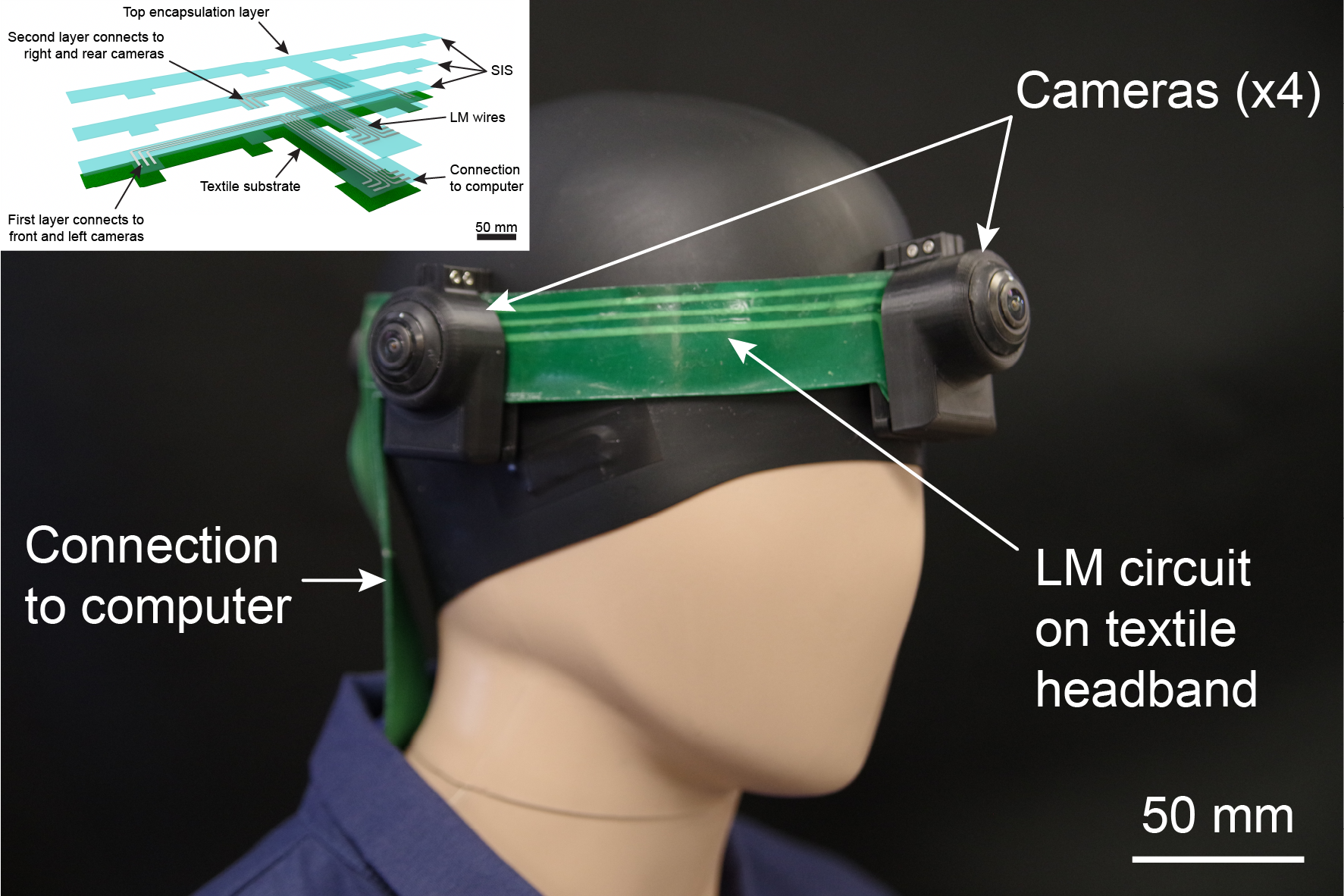
We integrate liquid metal soft composites into textiles to create multifunctional circuits. These systems combine stretchability, multilayer architectures, water resistance, and textile compatibility, enabling advanced wearable technologies such as immersive sensing. Mechanistic insights guide interlayer adhesion design and reveal structure–mechanics–functionality relationships, highlighting the electromechanical performance of liquid metal conductors and their reliable operation in aqueous environments.
Publications
● Textile-integrated multilayer liquid metal soft circuits for multi-environment wearable electronics. B.T. Wilcox, E.T. Williams, M.D. Bartlett. Materials Horizons, 2025. [PDF]
Conductive Composites for E-Textiles

We develop new materials and processes to enable iron-on circuits, creating on-the-fly robust integration of wearable devices. These use thermoplastic elastomer liquid metal composites which are electrically conductive without post-processing for use as conductive fabric adhesives in e-textiles and wearable electronics.
Publications
● Liquid Metal Adhesive Composites for Iron-On Wearable Electronics. J. Joyce, B.T. Wilcox, A. Ingram, M.D. Bartlett. In revision, 2025
Multilayer Soft Electronics

We overcome longstanding challenges in soft electronics and develop multilayer soft devices by creating soft vias and planar interconnects using liquid metal droplets and programmed photocuring. UV exposure effects at mask edges guide droplet assembly into vertical, stair-like structures, forming spatially tunable, conductive pathways in polymers. This 3D stratification seamlessly integrates with planar interconnects, enabling reliable in-plane and through-plane connections for soft and stretchable electronic systems.
Publications
● Soft electronic vias and interconnects through rapid three-dimensional assembly of liquid metal microdroplets. D.H. Ho, C. Hu, L. Li, M.D. Bartlett. Nature Electronics, 2024. [PDF]
DURABLE UNDERWATER ELECTRONICS

We demonstrate that liquid metal composites retain stretchability and electrical conductivity during underwater aging, making them strong candidates for soft electronics and sensors for wet and underwater environments. Current work investigates how unique electromechanical properties—such as conductive pathway formation, conductivity under strain, and self-healing—are preserved in ambient, freshwater, and saltwater environments, ensuring reliable performance in diverse operating conditions.
Publications
● Liquid metal-elastomer composites for water-resilient soft electronics. E.J. Barron III, E.T. Williams, D.H. Ho, M.D. Bartlett. Journal of Polymer Science, 2024. [PDF]
● Self-healing liquid metal-elastomer circuits for robust underwater electronics. E.T. Williams, M. Cecchi-Rivas, M.D. Bartlett. In submission, 2025.
System Integration with Liquid metal Composites
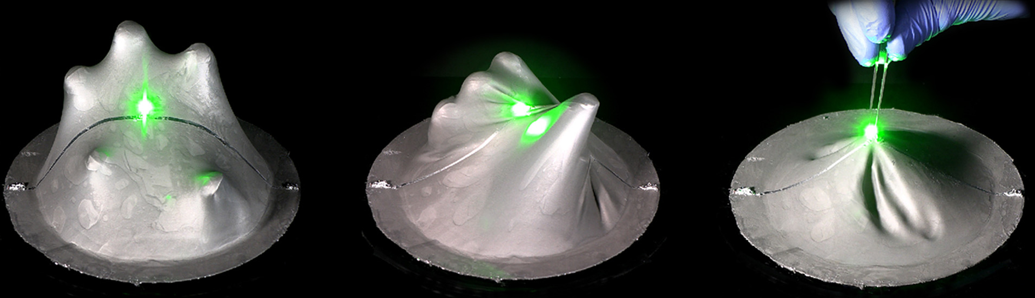
We enhance the integration of liquid metal composites into integrated systems by addressing adhesion challenges. We introduce both chemical anchoring to increase adhesion and an electrically conductive adhesive film to enable strong adhesion of liquid metal composites to diverse substrates. These approaches overcome key obstacles in hybrid electronic systems, supporting reliable component integration and advancing emerging applications in soft electronics, soft robotics, and multifunctional systems.
Publications
● Tough Bonding of Liquid Metal-Elastomer Composites for Multifunctional Adhesives. T.A. Pozarycki, D. Hwang, E.J. Barron III, B.T. Wilcox, R. Tutika, and M.D. Bartlett. Small, 2022. [PDF]
● A Flexible and Electrically Conductive Liquid Metal Adhesive for Hybrid Electronic Integration. T. A. Pozarycki, W. Zu, B.T. Wilcox, and M.D. Bartlett. Advanced Functional Materials, 2024. [PDF]
Stiffness Tunable Composites

We developed a unified model of magnetorheological elastomers (MREs) to predict stiffness and energy loss based on material architecture and applied magnetic fields. This model enabled the design of MREs capable of a 70× change in stiffness within ~20 ms. A soft gripper demonstrates their rapid, tunable mechanical response, highlighting the potential of MREs in adaptive soft robotics.
Publications
● A unified understanding of magnetorheological elastomers for rapid and extreme stiffness tuning. E.J. Barron III, E.T. Williams, R. Tutika, N. Lazarus, and M.D. Bartlett. Royal Society of Chemistry Applied Polymers, 2023. [PDF]
● The magneto-mechanical coupling of multiphase magnetorheological elastomers. E.J. Barron III, E.T. Williams, N. Lazarus, M.D. Bartlett. Journal of Physics Condensed Matter, 2025. [PDF]
Multimodal Morphing Robots

We introduce a rapid, reversible morphing robot through a bistable latch-mediated, spring-actuated (LaMSA) mechanism. This design enables an untethered robot to switch near-instantaneously (<50 ms) between flying and driving configurations, providing multifunctional mobility. The system demonstrates how reconfigurable mechanisms can navigate diverse environments, highlighting new opportunities in adaptive and multifunctional robotic systems.
Publications
● Rapid and Reversible Morphing to Enable Multifunctionality in Robots. B.T. Wilcox, J. Joyce, M.D. Bartlett. Advanced Intelligent Systems, 2025. [PDF]